EDITOR’S NOTE: This post is the first in a series that will explore different aspects of the Meeting Street Schools’ instructional model through the voices of teachers, students and leaders who live this work every day. The following piece was written by Chief Academic Officer Nisha Vasavada.
In a single year, our students grew an average of 1.6 years in reading and math while students performing at or above grade level improved by an average of 13 percentage points.
That kind of progress doesn’t happen by accident. These early results are directly connected to a deliberate overhaul of our instructional model over the last 18 months.
Three core shifts have made this possible:
- A crystal-clear instructional model
- Relentless alignment to a vision of excellence
- Effective coaching for leaders and teachers
1. A crystal-clear instructional model
Across the country, many well-intentioned systems fall into a common trap: confusing more with better. Buzz words like “student lift” and “differentiation” are widely used but rarely enacted in ways that fundamentally change student outcomes.
At Meeting Street Schools, we believe clarity is kindness, especially in classrooms. Our instructional model begins with a shared, precise vision of high-quality teaching and learning.
We don’t leave the what or the how to chance. Instead, we articulate with precision what effective instruction looks like, sounds like and requires. Then we simplify the practices that make a difference: students know what to expect in a lesson, teachers have clear visibility into student thinking (e.g. pencil to paper) and all students participate and are pushed to critically think.
This level of clarity allows teachers to focus their energy where it matters most: making nuanced instructional decisions that deepen student thinking. For example:
- Which sample from a student’s work – a common misconception, an inefficient strategy or a model response – will I use to help the class understand today’s math concept?
- What student response do I actually want from this question that will demonstrate their true understanding? What are my students likely going to say instead? What question can I ask to bridge the gap?
These are questions worthy of teachers’ brain space. Our instructional model doesn’t make teaching easy. But with time and practice, the work becomes more manageable and more impactful, and that is how instructional quality improves at scale.
2. Relentless alignment to a vision of excellence
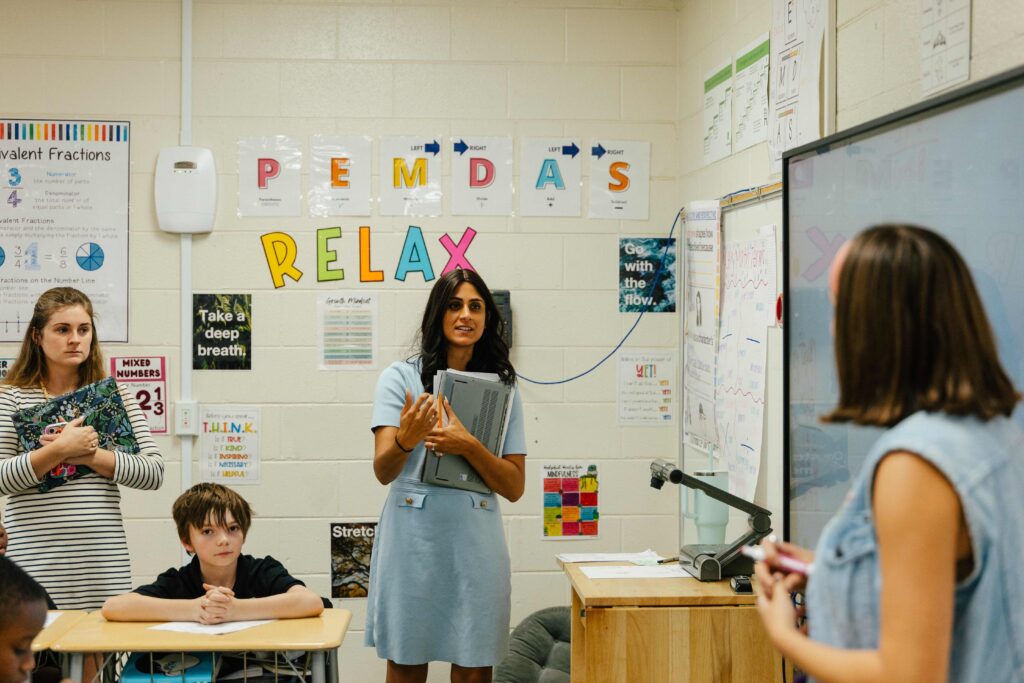
Alignment is visible in our schools. Whether it’s a second-grade math classroom in Spartanburg or an eighth-grade math classroom in North Charleston, our lessons follow a similar sequence: students’ work is selected for display, then students are asked to analyze and discuss it in a way that pushes their thinking. The content and rigor differ, but the underlying practices are shared.
Because these routines are predictable and consistent, students understand them. They know when they’ll be asked to turn and talk, justify their thinking or respond to a peer’s idea. Over time, they take greater ownership of their learning.
This predictability also supports teachers in planning with intention and precision. They anticipate student responses, script questions and potential discussion threads, identify which student work to display and plan feedback. Early on, this level of preparation can feel overwhelming or overly prescriptive. But once the underlying framework is learned, it becomes second nature. Instruction stops feeling like reinvention and starts feeling like craft.
To be clear, relentless alignment does not mean a lack of innovation; in fact, it enables it.
3. Effective coaching for leaders and teachers
An instructional model only comes to life through constant coaching and skill building. Documents, videos and curricula alone are not enough to ensure implementation matches vision.
At Meeting Street Schools, coaching is organized around a small number of clear priorities each year. These priorities, which we call Arcs, focus on four specific classroom practices that have the greatest impact on student learning. Our Arcs are: student culture (students learn routines and habits needed for success); rigor (students practice critical thinking); feedback (students show they understand high-quality work); and mastery (students take ownership of their learning and transfer it to multiple contexts).
Each Arc is defined by what students are doing and producing, not just by what teachers are doing. By focusing on a few priorities at a time and sequencing them intentionally, Arcs create shared clarity across the school and help teachers and coaches improve through manageable, concrete steps rather than trying to change everything at once.
Coaching happens every day in our schools, and our leaders have a clear goal: leave the classroom better than you found it. If something needs to shift, it happens in real time because every moment matters for students. While live coaching can feel uncomfortable at first, when done well, it accelerates growth. Teachers also see leaders being coached in the moment, reinforcing a culture where everyone is learning together.
With alignment on vision, coaching and daily practice, teaching and coaching stops being a game and becomes a learnable, improvable craft.
Life-changing education for students
What we’ve built is not dependent on a specific governance model, student population or magic bullet. It reflects a way of thinking about schooling that we know works but has slipped away from many. Our approach values learning by doing and an unwavering belief in both students and adults paired with high expectations and supportive accountability.
Our mission is empowering children with the excellent, life-changing education they deserve, and our work is far from finished. Our students deserve opportunities and options, so they must be equipped with an education that allows them to pursue the passion or career of their choice.
From an instructional perspective, our next steps include deepening quality, building capacity and ensuring our work is sustainable and owned collectively.
We’re not interested in creating a system that improves outcomes through a secret sauce of heroics, burnout, digital platforms, or a special talent pool. We’re building a school model that is simplified, innovative, joyful and teachable over time.
Because when we truly center students rather than adult politics, we create the conditions for real, systemic change.